Golden Llamas and Sex Pottery: What I Did Not Learn in AP World History

There’s a chart in the largest archeological museum in Lima listing the eras of indigenous history in Peru next to corresponding events in western history. I pride myself on being a well-educated person, but I recognized none of the ten or so civilizations that existed in northwestern South America during the times of Augustus, Charlemagne, Suleiman.
The education I’ve received has been a classically western one. I tried to supplement my education with courses in college and a wide variety of reading, but South America, for whatever reason, has been a massive blind spot in my formal and informal education. I landed in Peru without even a framework to work from. And as a French man who has been traveling in South America for a year told me, traveling to a place without knowing its history is painfully superficial. He used to be a chocolate-maker in France, and left his job because he felt it was too superficial.
I am guessing you might be like me. Most Americans who remember high school history know about the Incas (in Peru) and the Aztecs (not in Peru). So let me give you, at the very least, a framework for understanding a little bit of Peruvian history.
People have inhabited the lands now known as Peru for around 15,000 years. The first identified civilizations date to around 6000 BCE. You might recognize the names of some of the cultures because modern cities in Peru are often named after them: Nasca (as in, the Nasca Lines), Lima, Paracas. Much of the pattern in the museum I visited (Museo Larco), was from the Moche people. These cultures moved around and overtook one another as you’d expect.
To illustrate, let’s go to the Huaca Pucllana ruins in Miraflores, the neighborhood I stayed in while in Lima. The guide told us that in order to enter the complex, we HAD to take the tour, the tour was mandatory and compulsory. She was big on synonyms. Huaca Pucllana was a temple complex used by three different cultures, now in the process of slowly being excavated from sand dunes that used to be used for motocross. It also contains multiple tombs, tombs for young women who were sacrificed for rainfall, tombs for people who died of old age, buried alongside babies who were thought to remember the way into the next world (since, presumably, they had just come from it). People were buried upright in the fetal position, bodies swaddled in ropes, leaves, and fabric to symbolize a womb. The idea was, they would be reborn into the next life.

These details are grisly at first, but they can be contextualized. I reminded myself this as I stood alone in a room full of Incan mummies in Cusco and prayed that I would not have nightmares. Viewing death as the end, as something to be feared above all else and avoided at all costs, is a relatively modern attitude. Ancient peoples of all religions viewed death as a natural part of life, and lived their day-to-day lives preparing for a good death, a death that would result in easy passage to the next life.
It’s always humbling to see a different culture’s take on those things that are such a huge part of the human experience. You are reminded that there are worldviews vastly different from this globalized westernized one, that there are in fact different ways to look at these things. Not better or worse, just different. Death is certainly one of those things. I like our modern attitude of living for life instead of death—because life is here, it’s certain. What happens when we die is uncertain.
The other big thing is sex. There was an entire gallery in the Museo Larco dedicated to “erotic” pottery. I thought, you know, I’ve taken art history, I’m interested in this from an intellectual perspective. I can call an item “phallic” with the best of them. But I’ve never seem anything like this. There were ceramic depictions of humans, skeletons and animals engaging in (I’m going to use the highbrow terms here) fellatio, various forms of intercourse in varying positions, some of which would not result in procreation, both male and female genitals, including anthropomorphic penises with faces. Everybody looked like they were having a great time.

Then the exhibit ended, tongue-in-cheek, with a Madonna and Child painting and a short description of how attitudes towards sex, sexuality, and the female body changed with the introduction of Christianity, a religion literally premised on a virgin birth, the idea that sex is what transmits the taint of original sin. Gone is the joy we see in the ceramic sculptures.
Now, I am not dismissing everything that Christianity says about sex outright. I think that sex should be sacred and valued as something special and intimate. But I don’t agree that the only purpose of sex should be procreation. As the ceramic statutes indicated, sex can be a source of joy! It can also be a powerful way to connect with others, connect with yourself, and connect with something bigger than ourselves, something that unites us as humans. The gallery of “erotic” pottery was open to all visitors, it wasn’t clogged with warnings about the graphic nature of the exhibit, and I think the museum has the right idea. I think more of us might benefit from a visit to a room full of sex pottery.
Now that we’ve explored cultural relativism a little and talked about penises, let’s move on to the civilization that is mentioned in AP World History: the Incas.
The El Niño phenomenon eventually pushed civilization inward, away from the desert that is the Peruvian coast, and towards the Andes, where the Incas began conquering smaller peoples and consolidating their empire to become the largest in the Americas. I feel like I was taught to think of the Incas as part of prehistory, but that’s very much not true; the Incas were incredibly technologically advanced and a highly sophisticated people. And they were pretty recent! Much more recent than the Romans, who feel so much more familiar to those of us schooled in the U.S. (six years of Latin may have something to do with that too).
The reason less is known about the Incas in the west is primarily because Quechua, the 5,000-year-old language of Indigenous Peru, wasn’t written down. Therefore, everything we know about the Inca Empire at its height comes from Catholic missionaries and Spanish conquistadors, and those men of course have an incentive to downplay how sophisticated the Inca were to justify their invasion and colonization as benevolent. The narrative of “we’re bringing a better life to these backwards people” doesn’t work if those “backwards people” can move 100-ton stones without horses and build earthquake-proof temples.
The Incas’ capital was Cusco, and the name means “navel of the world” in Quechua. The Incan Empire radiated outwards from Cusco like sunbeams, an intentional metaphor because the Inca worshiped the sun. Their religion was very much a nature-based one, devoted to “pachamama,” or “Mother Nature.” Three animal deities represent the sky (the condor), the earth (the cat), and underground and therefore the land of the dead (the snake). Life in the Andes was not easy. The air is incredibly thin, the soil is arid, the weather is unpredictable and extreme. Spending a lot of time praying for nature to take it easy on you makes sense.

The Incas (and civilizations before them) also had other ways to adapt to the harsh environment. They tended to be much shorter and barrel-chested, allowing for a more favorable lung-to-body ratio. The average man in Peru today is 5’2”, and the average woman is 4’9”. Me, a giant by comparison, and my puny lungs are less able to thrive in air that contains only 60% of the oxygen that it does at sea level. People in the Andes also chew coca leaves, a mild stimulant that helps with altitude. Today, you can find coca tea on the menu in every restaurant and café in Cusco. I did have tea brewed with coca leaves and Andean mint…I can’t tell you how the coca tastes, because the mint overpowered it.
And if you were conquered by the Inca, life was not pleasant. You essentially became free labor, forced to work on the Incas’ vast network of roads (the largest in the Americas) and terraced agricultural system. This is actually one of the reasons the Spanish were ultimately able to conquer the massive Incan empire with a comparatively tiny group of men and horses: they allied themselves with groups who decided they’d rather be conquered by the Europeans rather than the Inca.
Three other things significantly contributed to the Spanish victory: the disease they brought over from Europe, against which native populations had no immunity, their horses, which the Incas had never seen and didn't know how to fight, and the fact that when Pizarro and his crew decided to go to Peru, the Incan empire was on the brink of civil war. The previous king had died of smallpox without designating a successor, and so two men claimed to be the Saca Inca, the king. Atahualpa, in the north, and his half-brother, Huascar, in the south and in Cusco. A house divided among itself cannot stand, and all that.
The Spaniards swooped in after the defeat of Huascar and captured Atahualpa. Atahualpa offered Pizarro nearly six tons of gold and silver in ransom for his freedom, which Pizarro took, of course, executing Atahualpa anyway and installing Huascar's younger brother as a puppet ruler. Killing Atahualpa was not a popular decision, either in Peru or in Spain. The king of Spain didn't like it because he didn't want to set a precedent of killing monarchs. Pizarro's men didn't like it. And the Incas didn't like it. And, of course, there was the matter of the largest ransom in history having been for nothing.
The Inca used gold in religious ceremonies, its brightness symbolizing the light of the sun. The gold was shaped into anything you can imagine: plates, people, llamas, jewelry, headdresses, and even a solid gold throne for the emperor. Qorikancha, the most sacred temple in the Incan religion, compared by my walking tour guide to the Vatican, was covered nearly wall-to-wall with gold on the inside. The Spaniards melted it all down and reshaped it into gold bars, shipping some back to Spain to fund the crown's various religious wars and dividing the rest among the conquistadors themselves.

Peru is incredibly proud of its heritage. Spanish, Quechua, and Aymara, another indigenous language, are all official languages. That’s not to say that there hasn’t been a significant amount of political turmoil in recent years. The current president is the daughter of a dictator who was elected in the 1980s, during a period when Peru was rocked by leftist terrorist activity. He used the terrorism as an excuse to dissolve the legislature…he was eventually removed from office due to “moral unfitness.” And his daughter was just elected. Do with that what you will. The economic situation is also not great; living here can’t be easy. For a place that used to be home to a superpower, it’s a little hard to see what has happened. What would Peru be like if all of that gold hadn't been stolen? If the wealth of a nation hadn't been plundered and never repaid?
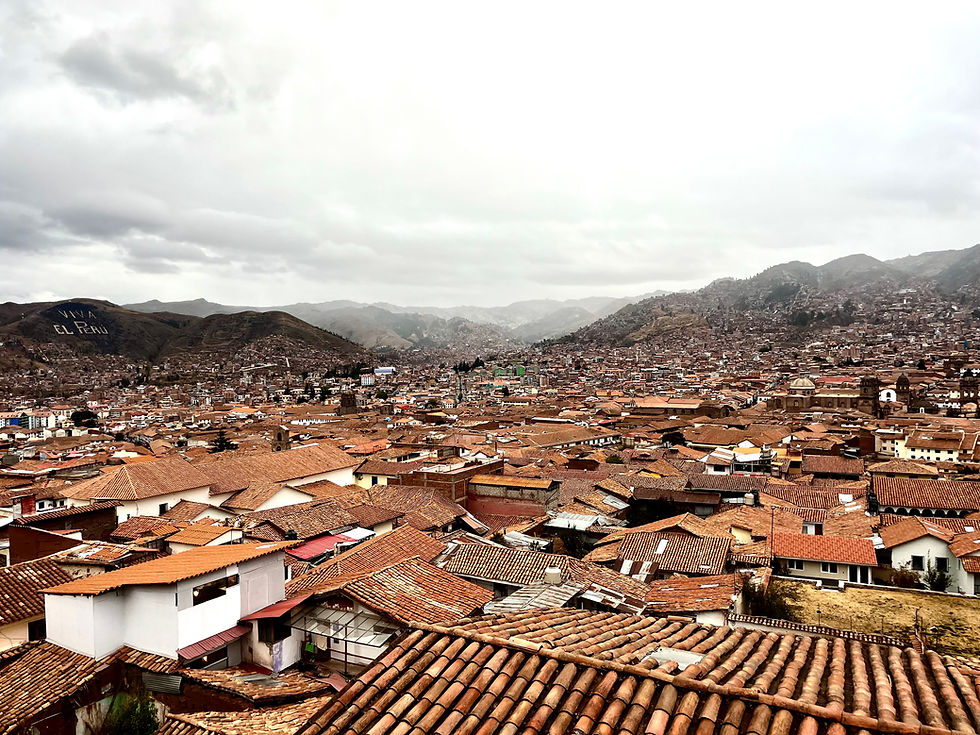
Today, modern Cusco is built on the ruins of the old Incan capital. You can walk through the streets and see which walls are from Incan times—dark stone, perfectly shaped and fit together without any cement or clay. It's not the city of gold it once was. But it’s still really special to be in a place like this, really special.
Comments